
Images & information related to the fictional island of Naboombu, as depicted in Walt Disney Productions' 1971 film Bedknobs & Broomsticks
This, Mary Poppins, The Jungle Book... Disney just riffing on source literature has yielded a lot of magical stuff. It also often meant that things were changed without obvious reasons. Like, in the book Emelius Browne was named Emelius Jones and why they changed that probably isn't an interesting story. But how they got from a stereotypical tropical island with dangerous natives in the book to a different island with a talking lion king wearing the pendant of a murdered sorcerer around his neck as he goes off to play football with crocodiles and warthogs in the film... that we need to know.
Sadly, I don't think we'll ever know the whole story behind that, but hope I'm wrong. Maybe answers lie in the Walt Disney Archives or in lost drawings to one day be found. We can, however, try to figure out what happened with at least the evidence on hand.
 |
| Illustration from A Visit To Naboombu Tell-A-Tale Book, 1971 |
~ WYW ~
 |
| The island of Ueepe in a 1943 illustration by Waldo Peirce |
For starters, the Island of Naboombu, its inhabitants and what it looked
like has been a fixation of mine since my child brain first started processing references to Disney's Bedknobs and Broomsticks (1971) when I was around four
years old, in 1973.
Why the island and its magical animals would resonate in the mind of a child
isn't hard to imagine. Why it still dogs me as a 55-year-old revolves heavily
around what I still don't know about its origins and have yet to conclude about
its crossed-referenced / proper mythology (something I do in my head with
things that have blanks yet to be filled in) and how *that* would be
transposed, Disneyesque, into an alternate post-1971 world. There are many
post-1971 versions with varying characteristics to look at in the real world.
The earliest reference to what would (eventually) be called Naboombu that I can
find is the "South Seas Island" of Ueepe in Mary Norton's original
1943 manuscript of The Magic Bedknob, which was first published as a book in
1944. The children Carey, Charles and Paul along with witch-in-training Miss
Price use their flying bed to visit the island and land along the edge of a
horseshoe shaped lagoon.
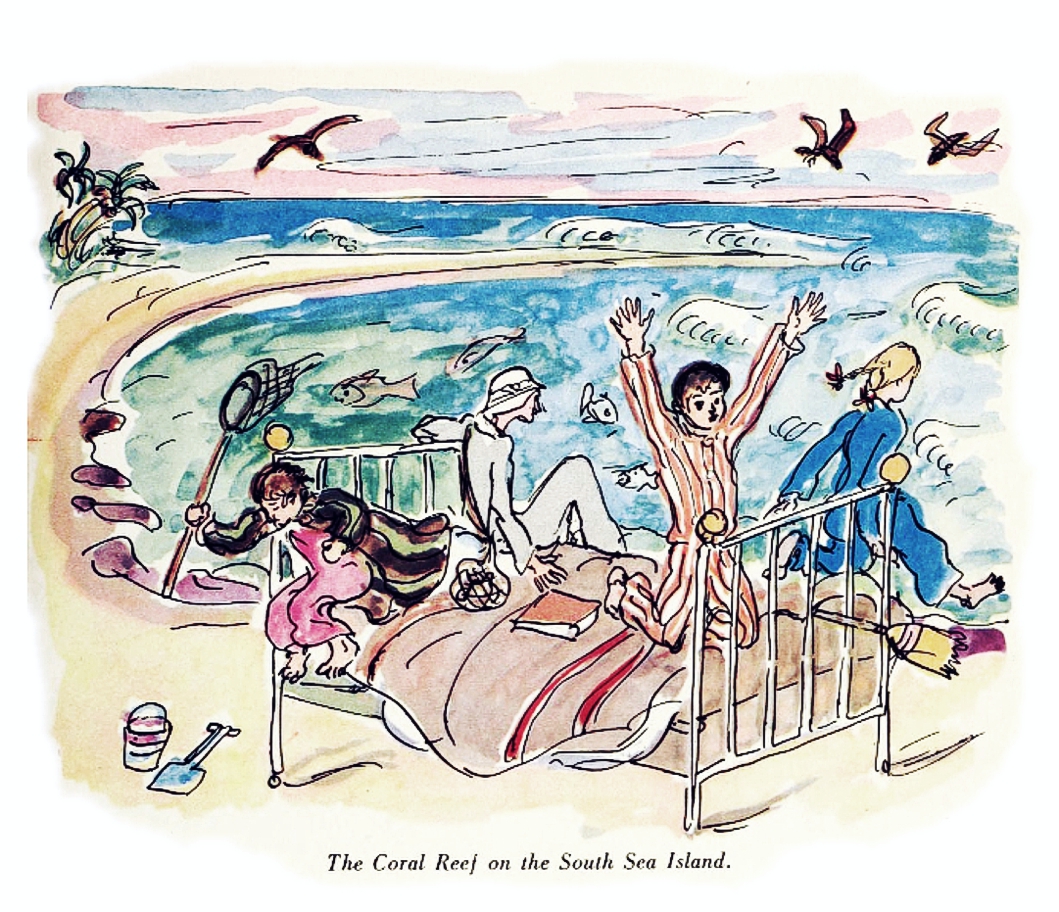
The same book contains the first illustrations of such an island by artist
Waldo Peirce.
~ WYW ~
In 1943's The Magic Bed-knob by Mary Norton, the name
Naboombu does not appear but the "South Seas Island" of Ueepe served
as a predecessor to the 1971 Disney film's Naboombu.
There is no reference to anthropomorphic animal inhabitants
of Ueepe - or elsewhere - in the books, but rather the island is populated by
cannibals. Their depiction would have been familiar to many readers in 1943 as
it was a racial characterization (generally racist via factual inaccuracies and
denigrating attributes) often ascribed to native societies of Africa, South
America and southern Pacific islands.
I'm still learning about that subject and can't speak well
to exactly how prevalent the cannibal trope was in English literature, but it
went back to at least the 19th century. In Norton's depiction, the cannibals
are led by a witch doctor and they capture Eglantine Price, Carey, Charles and
Paul. They escape as a result of Miss Price doing magical battle with the witch
doctor.
Note: They travel to the island because it's the one place
they could think to travel by magical bed in the daylight and not be seen by
anyone else who would be startled. In their encyclopedia set, Ueepe is
described as an island yet to be explored. Carey assumes that this means the
island is uninhabited, therefore safe to visit.
Erik Blegvad illustrated the 1971 edition of the book (which was combined with Norton's second book under the new title Bed-knob and Broomstick).
 |
| 1971 edition illustration of Ueepe by Erik Blegvad |
- "Towards the end of his life, Astoroth kept animals in cages and searched for the spells that would make them more like humans. The legend is that finally the animals rebelled at the experiment, killed Astoroth and stole many of his powers ... They found a ship, sailed away and were never heard of again. However, there's a final notation in my half of the book saying that in the seventeenth century, a shipwrecked lascar was taken from the sea, half mad with thirst and exposure to the sun. Before he died, he *swore* he had seen an island ruled by animals."
This account of the island's back story is genuinely ominous and captivating. It brings an element akin to H.G. Welles' 1896 book, The Island of Dr. Moreau, to Disney's fantasy film with just a couple well-placed lines. From that point forward in the script, however, Naboombu is treated with more humor than menace.
Over the next year, the Bedknobs team at Disney decided to incorporate more of the island of Naboombu into the film and give screen time to some of the animals that had been enchanted by Astoroth, or were at least descended from those humanlike animals.
 |
| Concept painting of Naboombu from Walt Disney Studios |

No comments:
Post a Comment